



Global Safety Management
KUISs Develops Global Leadership Skills Through its Commitment to Global Safety Management
KUISs believes that to be citizens of the 21st century, students need to be both globally-minded and committed to their local communities. With the transnational movement of people and the borderless transmission of information the idea of the "global" and "local" often blend together. A KUISs education welcomes these trends, emphasizing three education elements: Globalization, Leadership and Safety. As the University explains on its Japanese website(教育の視点)
"In this era of increasing globalization, there have also arisen risks to society that would never have been imagined in the past. This is not simply increased impacts from natural disasters and pandemics from around the world, but also other threats to social systems and business operations. In all these cases, there is need for different thinking and responses to the new reality.
For this reason, KUISs emphasizes its education along the three axes of "Globalization," "Leadership" and "Safety." To this end, all programs and students are supported in their efforts to develop skills and abilities in these areas. The university is committed to helping its graduates become citizens and professionals capable of taking an active, leadership role in a safe, prosperous society that understands and affirms diverse peoples and values..."
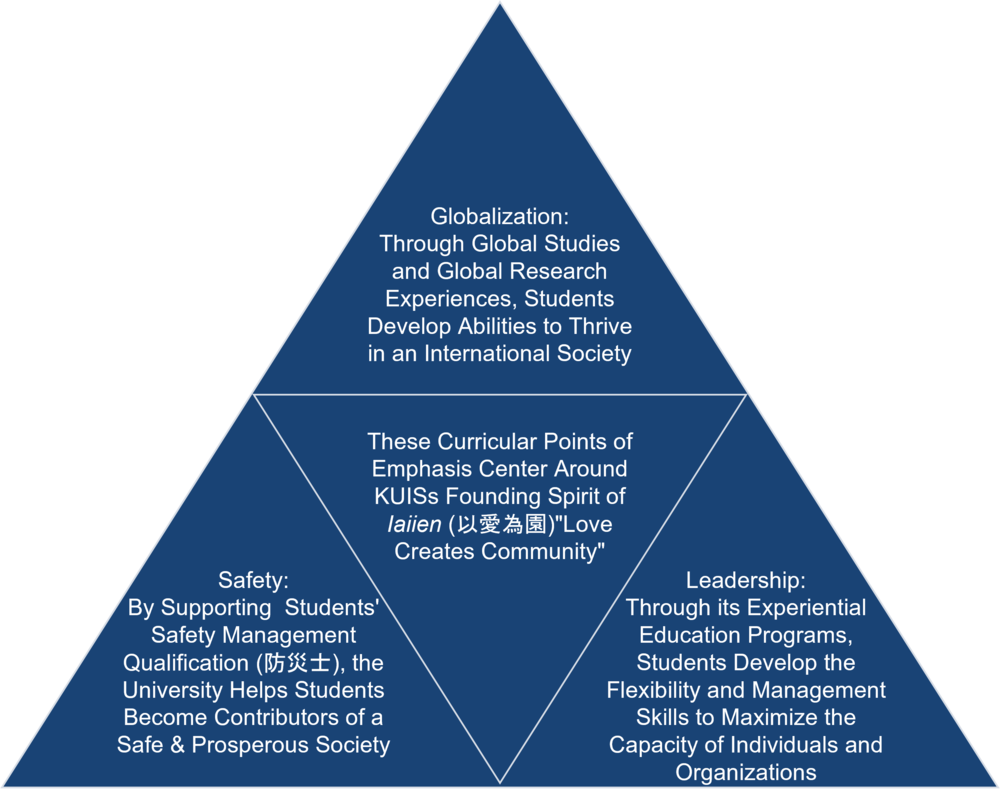 KUISs Three Educational Points of Emphasis (do we have a better file?):
KUISs commitment to these educational values are embodied in its founding value of iaiien (以愛為園), roughly translated as "Love Creates Community." KUISs' commitment to Globalization and Leadership is straightforward. Through its overseas exchange programs such as Global Studies or Global Research, students learn about the world around them and the cultures and values of diverse peoples. Similarly, KUISs students develop leadership skills through a range of experiential education opportunities. Through internships, service learning and project-based learning, students develop the flexibility and real-world skills needed to lead individuals and organizations.
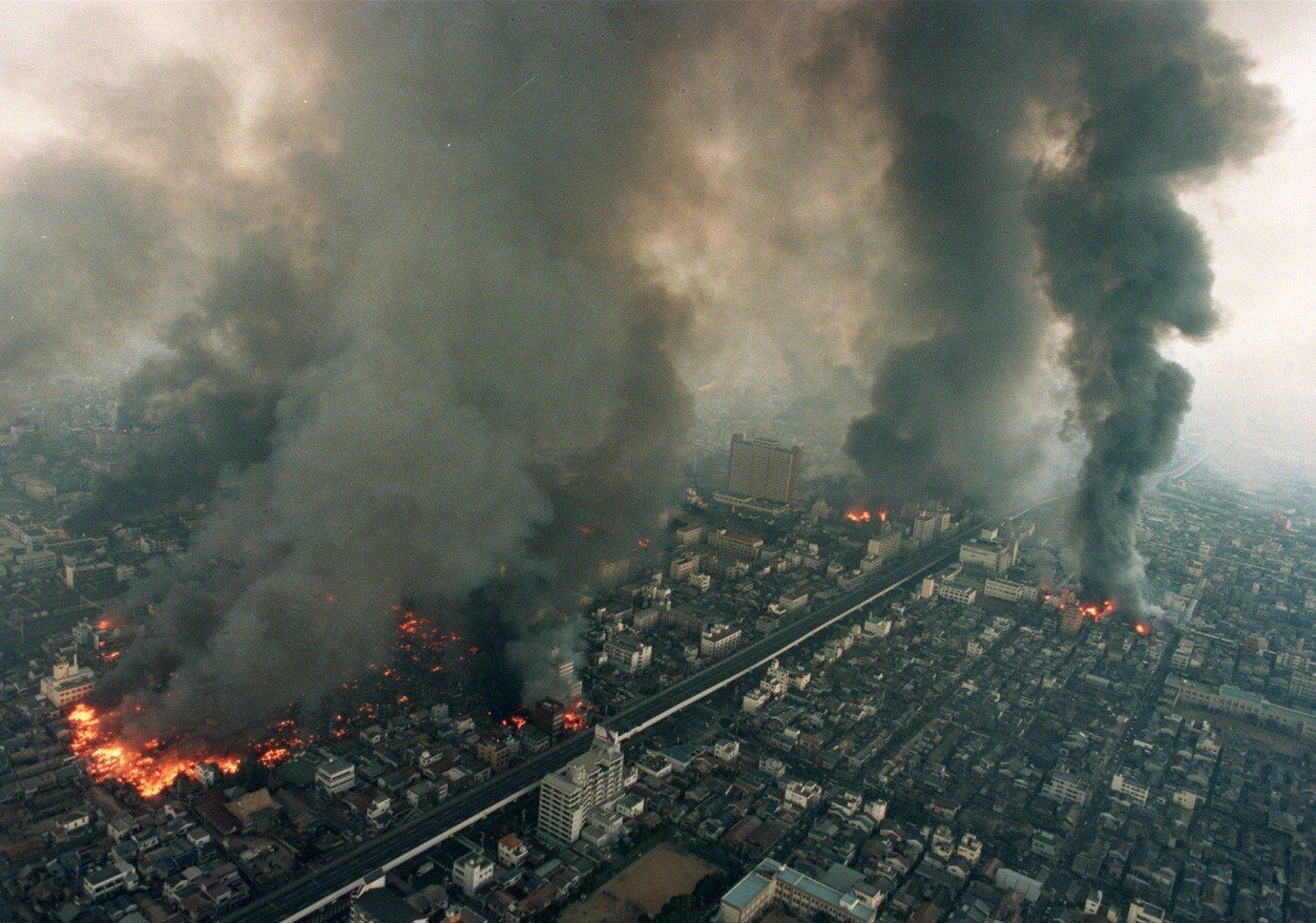 Photo of Disaster? Hanshin-Awaji Daishinsai?
But what about the 3rd value of "Safety?" This distinctive part of KUISs educational emphasizes the importance of having, safe, sustainable and resilient societies. In particular, community members must work together the develop a society-wide capacity to respond to and overcome whatever disasters or challenges nature or current events might bring. Such communities therefore need leaders who have the mental preparation and commitment to help their neighbors and fellow citizens in their times of greatest need. Cumulatively, such citizen-based leadership not only contributes to immediate society, but to the resilience and welfare of the world.
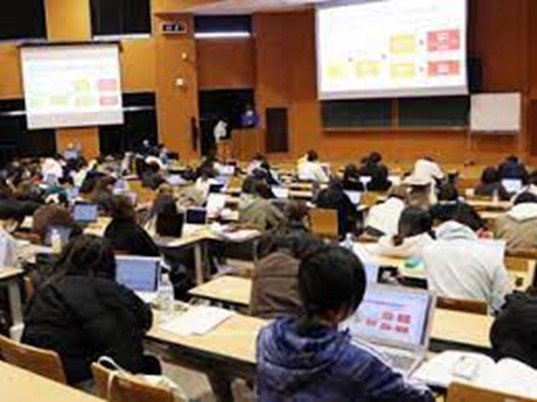
To help KUISs students become such citizen leaders, the University has taken the unique step of offering all of its students course-work qualifying them to become bosaishi (防災士), or "Safety/Disaster Prevention Managers." This national qualification, administered by the Specially Designated Non-Profit Organization, Japan Safety Management Organization (日本防災士機構|防災士資格の認定、防災士制度の推進 (bousaisi.jp)), certifies that qualification holders have the knowledge and prerequisite training to lead local communities and organizations in times of disaster. Sadly, Japan's long-history with natural disasters --be it earthquakes, typhoons, tsunami, floods and landslides-- has made it a pioneer in safety/disaster management education. This national qualification (acquired by passing a nationally administered exam) does not have many parallels worldwide. Nonetheless, KUISs realizes that exhibiting citizen leadership is not something that happens only in times of stability and prosperity. If anything, it is when crisis strikes that "grass-roots" leaders truly reveal themselves.
To this end, almost 1000 KUISs students have acquired the bosaishi "Safety Manager" qualification in recent years. This represents around half of all graduates over that time. (See below)
-
Safety Manager Qualification Holders
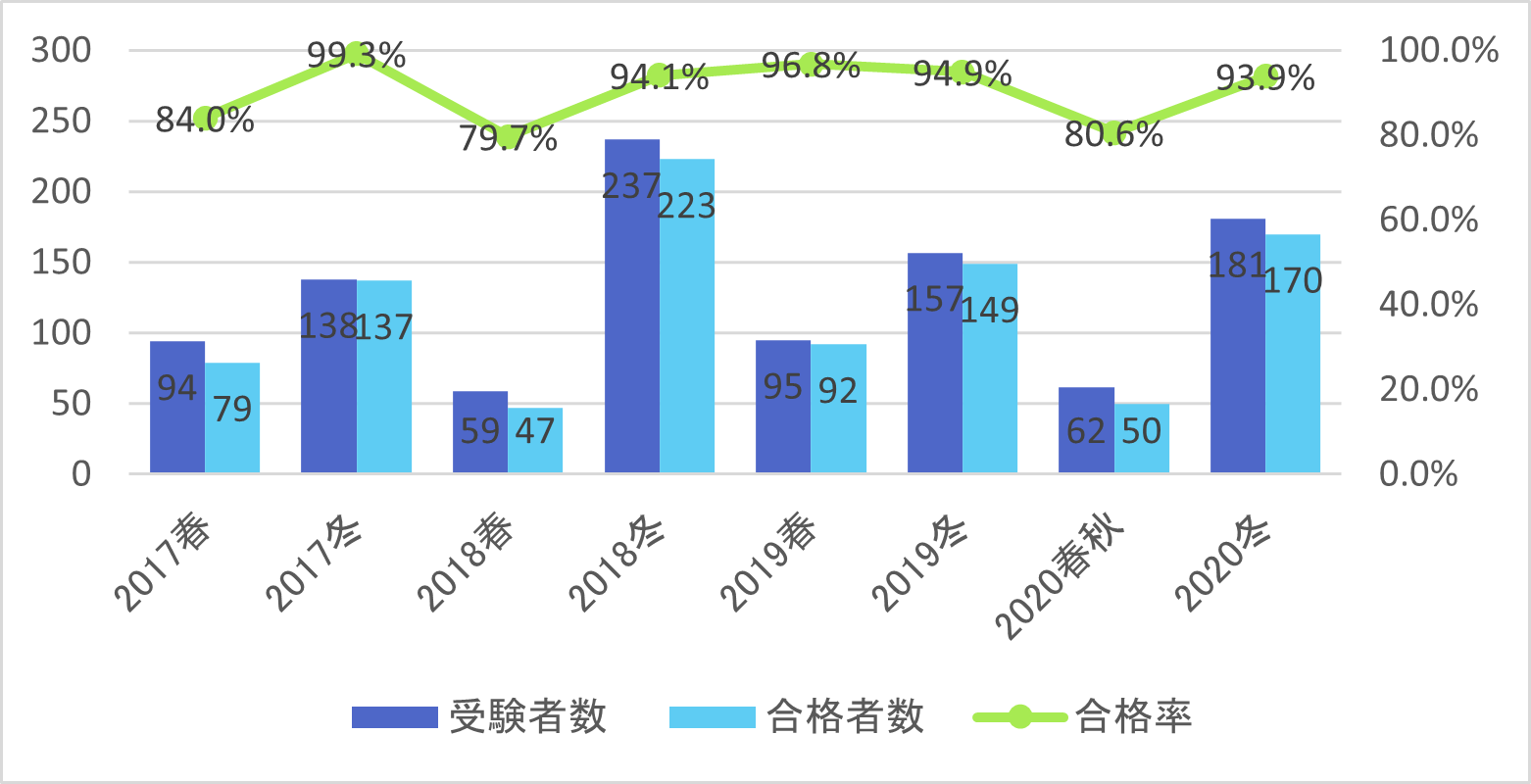
(Translations:春=Spring、冬=Winter、受験者=Qualification Exam Takers、合格者数=Number Who Passed Qualification Exam、合格率=KUISs Student Pass Rate)
※Note: These figures include adult students who took the course for credit.
Source: Safety Management Education Center (Community Engagement Section)
In 2019, KUISs further worked to spread safety management education overseas by founding a joint safety management program with fourteen universities from Malaysia, Indonesia, Vietnam, the Philippines, Myanmar and Thailand. It coordinated with both the Hyogo Prefectural Emergency Management and Training Center, the Japan International Cooperative Agency (JICA) and the Asian Disaster Reduction Center (ADRC) to develop relevant curriculum. KUISs hopes to bring this important expertise and knowledge to as many parts of the globe as possible. For more information on this, refer to the Asian Cooperative Program